






How to Reduce Overpayment and Interest on an Existing Loan
Publication date: 04.07.2026 12:00
2.1k
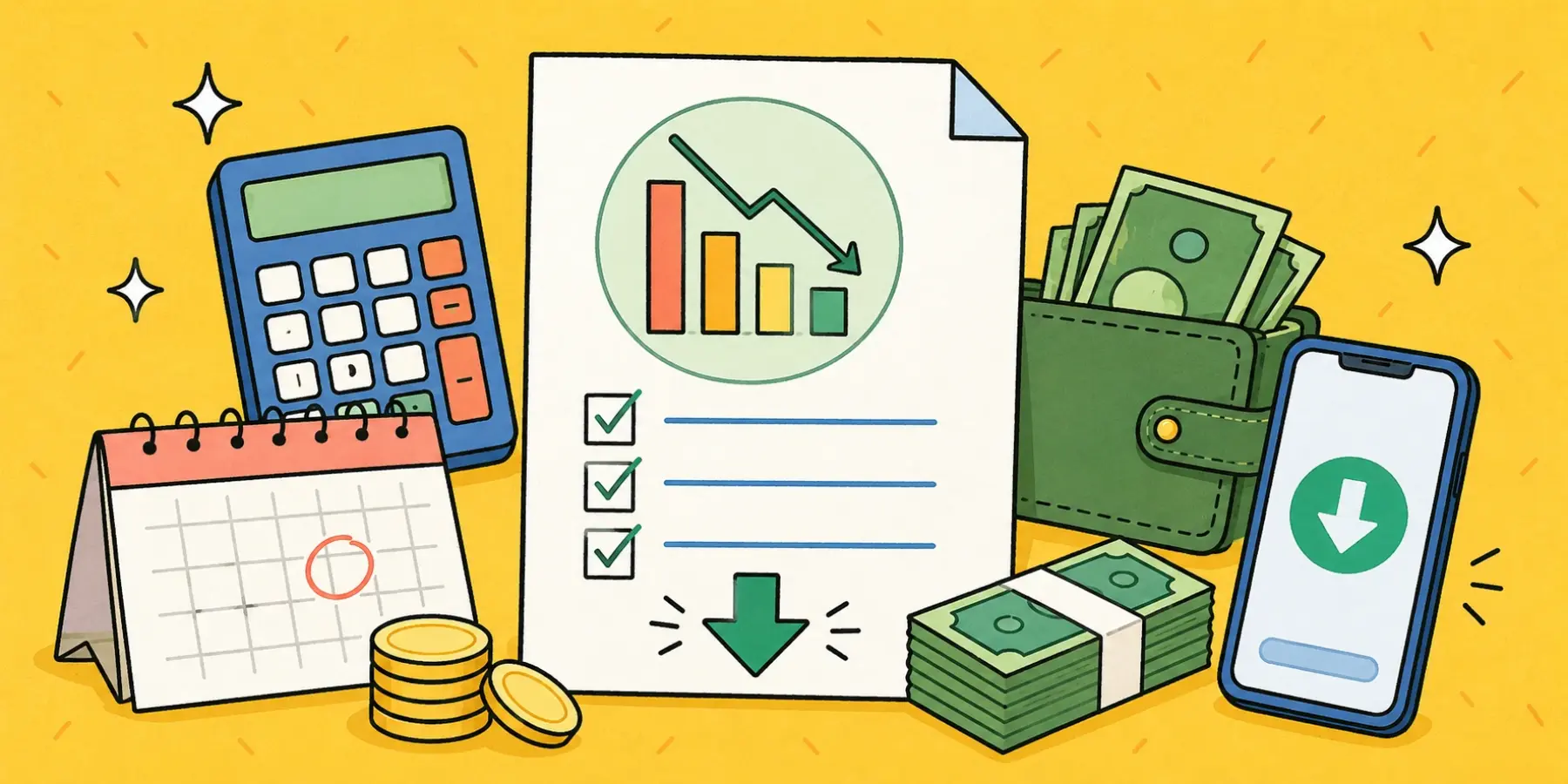
The loan has already been issued, the repayment schedule has been signed, and payments are deducted each month. It may seem that everything has already been decided. But that is not always the case. You can still reduce the total amount you overpay on an existing loan through early repayment, refinancing, discussions with your current bank, or a well-planned change to the term.
Important: reducing overpayment is possible, but the key to saving money is not the lowest advertised rate. It is a lower total cost of borrowing. Sometimes, a loan with an attractive “starting from” rate is more expensive than your current agreement. In other cases, a simple partial repayment delivers greater savings than refinancing.
What You Need to Know
A loan has two different “rates,” and confusing them can be costly.
The nominal interest rate shows the rate at which the bank charges interest on the actual outstanding balance. For example, 18% per annum.
APR, or the actual annual interest rate, shows the real cost of a loan, including mandatory charges. Under Armenian regulations, the actual annual interest rate includes interest and other mandatory payments the borrower must make when obtaining and servicing the loan.
So, do not compare advertising claims. Compare three figures: the outstanding balance, the total of all future payments, and the APR (Annual Percentage Rate) of the new offer. If even one of these figures is missing, the comparison is incomplete.
Options Worth Considering
Bank terms change, and the final rate depends on income, credit history, collateral, currency, loan term, and the bank’s decision. The information below was checked against official pages as of Jul 2026.
ACBA Bank: Mortgage Refinancing
What is stated: A special mortgage refinancing offer: 11.9% per year, floating rate, fixed period of 3 years, 0% service fee, APR 12.35%, currency AMD, term 12-240 months. The page also states that terms longer than 180 months are available only when buying property directly from a developer.
When it may help: If your current mortgage is more expensive and your outstanding balance is large.
What to check: The floating rate, term restrictions, and expenses related to collateral, valuation, notary services, cadastre, and insurance.
IDBank: Mortgage Loan Refinancing
What is stated: Mortgage refinancing: the new loan rate equals the refinanced loan rate minus 1 percentage point, but not lower than 12.95%; for loans from 25 million AMD — not lower than 12.50%. The terms are valid until 15.11.2026; APR 12.98%-16.70%; term — the remaining term, up to a maximum of 240 months; amount — up to 125 million AMD.
When it may help: If the bank truly lowers the rate and the new repayment schedule is cheaper than the old one.
What to check: The individual rate, loyalty fee, collateral-related expenses, possible reimbursement of costs, and idcoins in case of full early repayment within 24 months after the loan transfer.
Converse Bank: Mortgage Loans
What is stated: The terms clearly state the right to repay a mortgage loan early, either fully or partially, including through refinancing, and to choose either a lower monthly payment or a shorter term.
When it may help: If your goal is to reduce overpayment without changing banks, or through a new bank.
What to check: Early repayment penalties during the first 3 years: 0.6%, 0.4%, or 0.2% of the early repayment amount; fees, service charges, and APR.
Evocabank: Property-Secured Loan
What is stated: A personal loan secured by property with credit assessment: if secured by real estate, the amount is 2-100 million AMD; fixed rate 16%, actual 18.2%, term 24-84 months; floating rate — from 15%, actual 16.75%, term 36-120 months.
When it may help: If you want to replace expensive consumer debt with a cheaper secured loan.
What to check: APR, collateral risk, property valuation, insurance, rate format, and all one-time expenses.
Early Repayment of a Consumer Loan
What is stated: Under the consumer lending law, a consumer has the right to repay a loan early; the total cost of the loan is reduced proportionally, and the lender may not apply penalties. The law does not apply to all types of loans, so mortgages follow a separate procedure.
When it may help: If you have free funds and your goal is to reduce overpayment.
What to check: How the bank will recalculate the repayment schedule: by shortening the term or lowering the monthly payment; for mortgages, separately check any possible compensation/penalties.
Negotiating with Your Current Bank
What is stated: Terms are changed individually and depend on the bank’s policy.
When it may help: If you have made payments without delays and your income has become more stable.
What to check: Ask for a written offer with the nominal rate, APR, repayment schedule, and total amount payable.
What the Comparison Shows
The most effective options are not always the most visible in advertising.
Mortgage refinancing usually has an impact when many years remain on the term. Even a difference of 1-2 percentage points can be meaningful when the outstanding balance is large.
Early repayment is especially useful in the first half of the term. In an annuity repayment schedule, a larger portion of each payment goes toward interest at the beginning of the loan. The earlier you reduce the principal, the less interest will accrue later.
A secured loan can reduce the rate but increases risk. If the borrower does not make payments, the bank may enforce against the collateral. Therefore, converting regular consumer debt into a mortgage loan is only worthwhile if you have a stable income and a clear plan.
Step-by-Step Guide
Step 1. Get Your Current Repayment Schedule
You need the outstanding balance, the interest rate, APR, monthly payment, remaining term, and the total of future payments. This is your baseline. Without these figures, the comparison will be inaccurate.
Step 2. Calculate the “Do Nothing” Scenario
Add up all remaining payments in your repayment schedule. Then subtract the current outstanding principal. This will show the future overpayment you may still be able to reduce. Depending on the type of loan, you can use a loan calculator, mortgage calculator, or loan refinancing calculator to compare scenarios.
Step 3. Ask Your Bank to Review the Rate
This is the simplest route. You do not need to close the existing loan, arrange collateral again, pay a notary, or change banks. Strong repayment discipline, higher income, a payroll arrangement, or lower offers from competitors can support your request.
Step 4. Check Refinancing
Do not compare rates alone. Your calculation should include fees, collateral appraisal, insurance, notary costs, cadastre fees, service charges, a penalty or compensation for early closure of the existing loan, and costs under the new agreement.
Step 5. Do Not Automatically Extend the Term
Extending the term reduces the monthly payment but often increases total overpayment. It can be a sensible solution when you need to reduce financial pressure temporarily. But if your goal is to save money, it is better to keep the term unchanged or shorten it.
Step 6. Request an Individual Terms Sheet
An advertised rate is not a contract. Before signing, you need to see your personal rate, APR, repayment schedule, total amount payable, and all mandatory costs.
Practical Calculation
Suppose a borrower owes the bank AMD 5,000,000. There are 48 months left on the term. The nominal interest rate is 20% per annum. The annuity payment is approximately AMD 152,152 per month.
If nothing changes, future interest will total around AMD 2,303,287.
Now suppose another bank offers refinancing at 16% per annum for the same 48 months. The new payment would be around AMD 141,701. Interest over the term would total around AMD 1,801,667.
Interest savings would be approximately AMD 501,620. If the new loan’s arrangement, certificates, transfers, and other expenses cost AMD 80,000, the net benefit would be approximately AMD 421,620.
Now consider another scenario. The borrower makes an early payment of AMD 500,000 and keeps the existing monthly payment of AMD 152,152. The loan would then be repaid in approximately 42 months instead of 48, while interest savings would be around AMD 552,056.
Conclusion: if you have spare funds, partial early repayment with a shorter term often works better than simply reducing the monthly payment. But if you do not have a lump sum available, refinancing can be a good option.
Who It Is Suitable For
Refinancing may suit borrowers whose rate is materially higher than current offers, who have more than a year remaining on the term, and whose outstanding balance is substantial.
Good prospects include borrowers who have made payments without delays, have official income, a low debt burden, and can confirm the source of funds.
Early repayment suits those who have a reserve and no more expensive debts. For example, it is usually more sensible to close credit card balances, overdrafts, and expensive consumer loans before considering mortgage prepayment.
When It Is Better Not to Use It
Do not rush into refinancing if only a few months remain until the loan is fully repaid. Most of the interest has already been paid, and the costs of a new agreement may absorb any benefit.
It is risky to accept a new loan simply because the monthly payment is lower. If the term increases from 3 to 7 years, total overpayment may rise even at a lower rate.
You should also avoid converting unsecured debt into a loan secured by a home if your income is unstable. The rate may become lower, but the risk of losing the pledged property will be higher.
What to Check Before Applying
Ask the bank direct questions before signing.
- What will the APR be, not just the nominal interest rate?
- What is the total amount payable?
- Are there fees for origination, servicing, insurance, appraisal, notary services, or cadastre?
- Is there a penalty or compensation for early closure of the existing loan?
- Is the rate fixed or floating? If it is floating, how often can it change, and what is the maximum increase?
- Can the new loan be repaid early later without a penalty?
- What will change: the term, the payment, or both?
If the bank gives only general answers, request a written calculation. A loan should be clear before you sign the agreement.
Section for Non-Residents
For non-residents of Armenia, this topic is also relevant, but the process is usually more complicated. The bank may request additional documents: a passport, proof of income, account statements, registration, an employment contract, proof of the source of funds, and information about the collateral.
There are mortgage products on the market for non-residents of Armenia. For example, Evocabank publishes a separate product called Housing mortgages for non-resident individuals, while ACBA states that mortgage loans may be available to residents and non-residents of Armenia. However, this does not mean that every non-resident will be approved. Income, the country where the income is earned, currency, collateral, a co-borrower, and the bank’s internal rules all matter.
If your income is in a foreign currency, check currency risk separately. A payment in AMD and income in another currency may move differently when the exchange rate changes.
How to Choose the Best Option
The best option is the one with the lowest total cost of the loan, not simply the lowest monthly payment. The total cost includes not only interest, but also any mandatory expenses required under the loan terms: origination and servicing fees, insurance, collateral valuation, notary services, cadastral fees, and other charges without which the loan cannot be issued or serviced. That is why you should compare not only the interest rate and monthly payment, but also the APR and the total amount payable.
Use a simple formula: compare future payments under the existing loan with future payments under the new loan, plus all switching costs. If the new option is cheaper by a meaningful amount, it may be worth considering.
If the difference is small, it is better not to complicate the arrangement. Sometimes, savings of AMD 30,000-50,000 do not justify a new application, collateral appraisal, documents, and the risk of receiving less convenient terms.
If you have several loans, start with the most expensive debt. Paying off a loan at 25% is almost always more important than making an early repayment on a mortgage at 12-14%.
FAQ
Can you reduce the rate on an existing loan?
Yes, but the bank is not obliged to change the agreement automatically. You need to submit a request and receive a new offer. Sometimes a bank reduces the rate if the borrower has paid without delays and has become a lower-risk client.
Which is better: refinancing or early repayment?
If you have a lump sum available, early repayment with a shorter term is often more beneficial. If you do not have spare funds but another bank offers a noticeably lower total cost, refinancing may help.
Which matters more: the nominal rate or APR?
For comparison, APR and the total amount payable matter more. The nominal rate shows how interest is charged, but it does not always reflect fees and mandatory costs.
Can you reduce both the payment and the overpayment at the same time?
Yes, if the new rate is lower and the term does not increase too much. If the payment falls only because the term is extended, total overpayment may rise.
Does refinancing make sense if you have overdue payments?
The chances are lower. It is better to clear overdue amounts, stabilise payments, and check your credit history first. Banks look not only at income but also at the borrower’s repayment behaviour.
For early repayment, should you reduce the term or the payment?
For maximum savings, reducing the term is usually better. To reduce pressure on the budget, reduce the payment. These are different goals.
Can you combine several loans into one?
Yes, if the bank approves a new loan to close existing obligations. This can be convenient, but it is important not to extend the term so much that total overpayment increases.
Is a floating rate risky?
It is not inherently bad, but you need to understand it. Check the benchmark indicator, the review frequency, and the maximum rate increase.
Can a non-resident reduce loan overpayment in Armenia?
Yes, if the bank is willing to work with the person’s status and income. However, the list of documents and requirements is usually stricter than for a resident of Armenia.
Conclusion
You can reduce loan overpayment only after accurately calculating the terms and costs.
First, understand how much interest is still ahead.
Second, check whether your current bank can reduce the rate.
Third, compare refinancing by APR and total amount payable.
Fourth, use early repayment in a way that reduces not only the monthly payment but also the principal balance.
Most importantly, do not confuse a lighter monthly budget with actual savings. A low monthly payment can become a trap if the term is much longer. Real benefit arises when the total amount payable decreases.
Compare offers from Armenian banks, check the terms for loans and mortgages, and calculate the full cost of each option. Sometimes refinancing is more beneficial; in other cases, it is better to keep the current agreement and repay the debt faster.
Author
Davit GyulnazaryanSource
AFMTopic